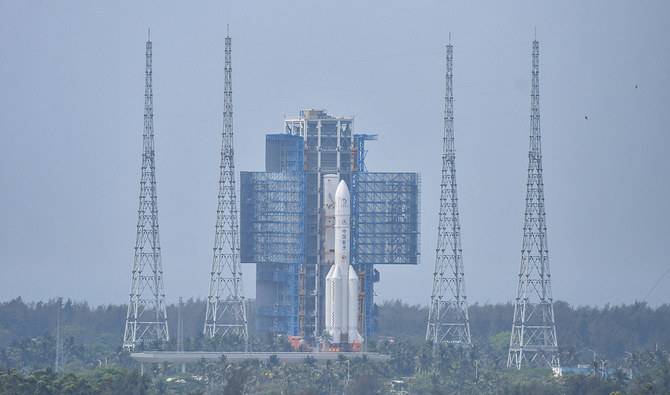
Pakistan’s first satellite mission to the moon ‘Icube Q’ will be launched from China’s Hainan Space Launch Site on May 3, which will be broadcast live on the Institute of Space Technology’s website and social media platforms.
Pakistan’s satellite mission will orbit the moon for three to six months. Meanwhile, various images of the moon’s surface will be taken with the help of satellites, which will be obtained only through China’s Deep Space Network.
According to the Institute of Space Technology, more information about the surface of the moon can be obtained with the help of satellite images. The mission will also expand Pakistan’s space program.
According to Dr. Khuram Khursheed, head of department at the Institute of Space Technology and core member of the ‘Icube Q’ mission team, ‘His institution has jointly launched the iCube satellite with China’s Shanghai University and Pakistan National Space Agency ‘Sparco’. has been designed and developed.
‘iCube Q’ is equipped with two optical cameras that will be used to take pictures of the lunar surface. After successfully passing through the testing and qualification phase, ‘iCube Q’ has been attached to the ‘Chang 6’ mission.
How Pakistan managed to send a small satellite into space?
Talking to Urdu News, Dr. Khurram Khurshid said that it was an opportunity for the member countries of Asia Pacific Space Cooperation Organization (APSCO) to send their own small satellite into space along with China’s moon mission ‘Cheng 6′. .’
He further said that ‘on the proposal of Epsco, the member countries sent their own proposals. The proposal was submitted by the Institute of Space Technology on behalf of Pakistan.
Epsco experts thoroughly reviewed the proposals of all the member countries and accepted only Pakistan’s proposal out of 8 countries, thereby allowing Pakistan to send its small satellite into space.
Who are the member countries of EPSCO?
Epsco member countries include Pakistan, China, Bangladesh, Iran and Peru. Apart from them, Thailand, Mongolia and Turkey are also Epsco member countries.According to officials, “Pakistan’s ‘IQUQ’ will successfully reach space with China’s mission” (File Photo: IST)
How come only Pakistan among the member countries of EPSCO got permission?
According to Dr Khurram Khurshid, ‘Institute of Space Technology Pakistan (IST) has been working on small satellites before. IST started work on Cube satellites (small satellites) in 2009.
“Earlier in 2013, IST had sent a small earth-orbiting satellite into space, so seeing the basis of these experiments and the impressive proposal, this time Pakistan was given the opportunity to send its own small satellite into space.”
It took two years to build the satellite: IST
Dr. Khurram Khurshid says that ‘IQUQ’ has been developed in a period of two years. Various tests were conducted during these two years, supported not only by the Space and Upper Atmosphere Research Commission (SPARCO), but also by Shanghai University.
China bears costs of sending mission to Moon: IST
Pakistan’s mission to send a small satellite to the moon is linked to China’s ‘Cheng 6’. Dr. Khurram Khurshid says that ‘EPSCO and China will bear all the expenses of this mission. Pakistan only has to bear the cost of making the satellite which does not amount to much money.’
What are the chances of mission success?
Dr. Khurram Khurshid of the Institute of Space Technology Pakistan said that ‘China has a special experience in sending missions into space.’According to Aerospace Engineer Dr. Fazeel Mehmood Khan, ‘Pakistan’s satellite has no comparison with the Indian mission’ (File photo: ISRO).
Pakistan’s small satellite will also be sent into space with China’s sixth mission. It is hoped that Pakistan’s ‘IQQ’ will successfully reach space with China’s mission.
Pakistan’s satellite to remain in space for three to six months: IST
Sat-satellites ‘iCube Q’ are small satellites known for their small size and standard design.
The satellite is equipped with two optical cameras (mobile cameras) that will be used to take pictures of the lunar surface. Pakistan’s satellite will be able to stay in space for three to six months. According to Dr. Khurram Khurshid, a member of the core committee of the ‘iCube Q’ satellite, ‘Cube satellites have been used for various missions.’
‘Cube satellites have been used for observing the Earth, studying the atmosphere, remote sensing, facilitating communications, astronomy and demonstrating new technologies.’
‘Because of their small size and lower cost than larger satellites, CubeSats provide opportunities for universities, research institutes and commercial companies to participate in space missions and collect data critical to scientific development and innovation.’Experts believe that sending ‘IQUQ’ to a satellite is not a big success at the national level’ (File photo: Wikipedia).
Aerospace engineer Dr. Fazeel Mehmood Khan believes that ‘Cubesat’ can prove to be a good experiment for university research, but it is not a big success at the national level.
In a conversation with Urdu News, he said that ‘Cubesat’ is basically a small satellite which is used by various universities or research institutes for their research.
“It may benefit students or institutions for research in aerospace, but it cannot be considered a major achievement at the national level.”
Talking about India’s moon mission ‘Chandrayan 3’ and Pakistan’s satellite mission ‘IQBQ’, Dr. Fazeel Mehmood Khan said that ‘Pakistan’s satellite cannot be compared with the Indian mission.’
India has landed on the south pole of the moon for the first time in history through Chandrayaan 3, while China will include Pakistan’s satellite with its main mission and leave it on the way, i.e. in space, which will orbit around the moon.
According to Fazeel Khan, ‘Pakistan’s space program is still stuck in the 60s and 70s, which is actually going in the wrong direction instead of moving forward.’
Pakistan needs to work seriously on space program. In this regard, China’s cooperation must be obtained, however, complete dependence on another country in the space program cannot guarantee success.